This content is for educational purposes only and is not financial advice. Investment values can fall as well as rise, and you may get back less than you invest.
This is one of the lessons that I learned later on in my investing education, and it's something you have to be aware of, particularly if you're interested in investing in 'foreign stocks / shares' that trade in their local currency – by this, I mean the very common scenario of anyone outside of the US deciding to invest in a US stock (as well as any other permutation of the scenario that you can think of).
In this scenario, investors have to be aware of more than just the price of the stock when they invested, and the price at the time of selling – most importantly, both the foreign exchange rate (/FX rate) between the local currency and the currency the stock is traded in; and the FX conversion fee that your broker will likely charge. The currency that the stock trades in, is always shown at the point, just before committing to an investment; but you may have to do a little more digging to find the FX conversion fee that your broker charges.
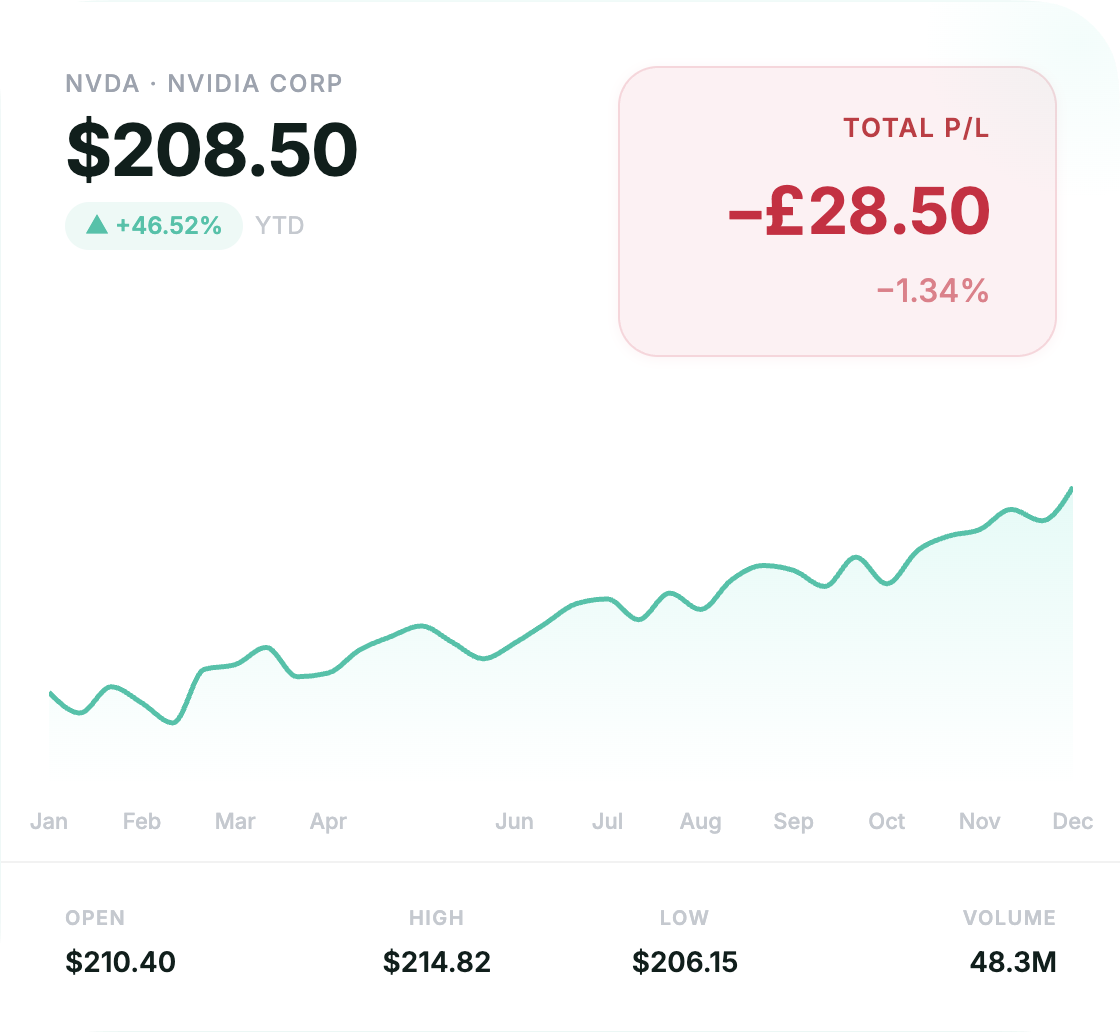
When investing in foreign stocks, it’s very possible that the profit or loss you initially calculated for the investment, may not be exactly what you thought, after looking back at your trading statements. In the most extreme cases, FX moves can turn a modest profit into a modest loss — but equally, a favourable FX move could enhance it. The point is, that trading foreign stocks, adds an addition variable of FX rates, you need to understand and account for, in either direction.
A hypothetical worked example
Some context first: the biggest one-day loss in pound sterling's history came after the UK voted to leave the EU — the UK pound tumbled as much as 13% against the dollar in a single day. Now imagine the reverse — a sharp sterling recovery of 10% — and what that would mean for a UK investor holding a US stock… if you’re confused already, no problem – here’s a step by step example to help you understand.
The following worked example uses hypothetical figures for illustrative purposes only. It is not a forecast or guarantee of returns. FX moves of this magnitude are extreme examples; most day-to-day FX moves are far more modest, but the mechanism is the same regardless of scale. Investment values can fall as well as rise, and you may get back less than you invest.
Assumptions: £5,000 invested in a US stock, GBP/USD FX rate of 1.25 at the time of buying the investment, FX conversion fee of 0.5% (exact rates vary by platform — always check your platform's fee schedule; 0.5% is used here as a common illustrative benchmark).
At the point of investing
You invest £5,000 at a GBP/USD rate of 1.25 (every £1 buys $1.25 of stock)
Your broker charges a 0.5% FX conversion fee: -£25.00
The remaining £4,975 buys $6,218.75 of stock
The stock does exactly what you hoped
The stock gains 5% in USD terms: +$310.94
USD value at sale: $6,529.69
In dollar terms, you're up — time to bring the money home…
The FX problem
While you were invested, GBP strengthened 10% against USD.
The rate has moved from 1.25 to 1.375 — meaning each pound now buys significantly more dollars than when you bought in.
Your dollars are worth fewer pounds than they were.
At the point of taking profit / selling
USD converted back to GBP at 1.375: £4,748.86
FX fee charged to sell (0.5%): -£23.74
Your new total received for the investment: £4,725.12
The outcome
You started with £5,000.
You ended with £4,725.12 — despite the stock gaining 5% while you were invested.
The FX rate move alone was enough to more than wipe out the entire 5% stock gain, the fees made it even worse — small in isolation, but they compound the problem.
Other investing fees worth being aware of
These fees, and the general mechanisms through which brokers earn money, are things every investor needs to understand. A common (but not exhaustive) list of charges to look out for:
FX conversion fees — charged when converting between currencies, both on entry and exit. Rates vary by platform; always check before investing.
Exchange rates — even before fees, the rate your broker applies may not be the mid-market rate. Some platforms build a small margin into the rate itself, on top of any explicit fee.
Spread — the difference between the buy and sell price of any investment. The sell price is always slightly lower than the buy price; this is how market makers profit from facilitating trades, and it's built into every quoted price rather than shown as a separate charge. If you bought and sold instantaneously, you would lose a small amount purely from the spread — perfectly normal, but worth understanding.
Commission — some brokers charge a flat fee per transaction (e.g. £x to buy, £x to sell), regardless of trade size. Others charge a percentage. Some charge neither, but recoup costs through spread or FX margin instead.
All of these are common across most investing platforms, though exact rates and structures vary considerably. Always check your platform's full fee schedule before investing — and factor these costs into any return calculation you make before committing to a trade.
I hope that sharing my past mistakes, may prevent you from doing the same, and improve your investing outcomes in a tiny way.
Meedo has been designed & built by a retail investor, for retail investors; and has some best practices of DIY investing built into how it works. Check it out and please help me make it even better, by sharing your thoughts and candid feedback through the feedback feature within the platform. Manage your own money – simply, smartly.